Qorinix inference control plane
A multi-tier model router across 12 LLM providers with streaming, a per-call cost ledger and usage-based billing, built for real-time agents, voice and trading alerts.
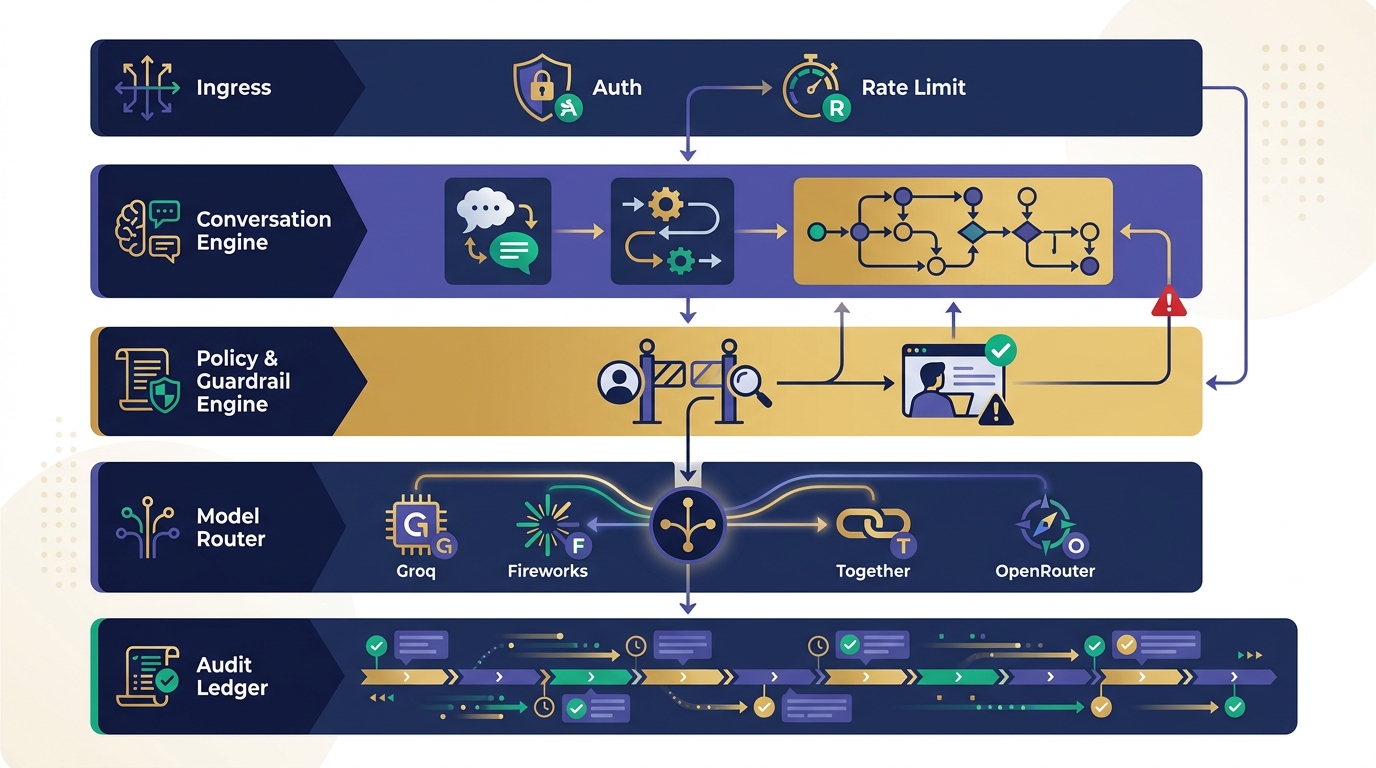
1 / 6
The board wanted "instant" AI responses for real-time agents, voice interfaces and trading alerts, and owned the decision on whether Qorinix would become a product rather than stay an internal capability. The end users are developers who call one API and expect a fast first token no matter which provider serves the request.
2 / 6
A hard latency budget (targeting sub-200ms time-to-first-token at p50), provider cost that had to be visible per call rather than discovered on the monthly invoice, and automatic failover when a provider degrades or rate-limits. A five-person team, so the design had to be operable without a dedicated platform crew.
3 / 6
A multi-tier router that classifies each request by latency sensitivity and routes it across 12 providers (OpenAI, Anthropic, Gemini, DeepSeek, Qwen, Groq, Cerebras and others), with streaming SSE end to end, a per-call cost ledger, usage-based billing and entitlements. Token tiering sends non-latency-critical work to cheaper or self-hosted models. I wrote the specification and the evaluation criteria; AI coding agents generated the code under a three-gate review and evaluation process, and I reviewed, tested and accepted every change.
4 / 6
- 12 LLM providers behind one API
- Groq and Cerebras LPU inference for the low-latency tier
- Streaming SSE
- Per-call cost ledger and usage-based billing
- Entitlements and API keys
- AWS and Cloudflare
5 / 6
Every call is logged with provider, model, latency and cost. Provider failover follows a deterministic fallback order. Model and provider changes go through the same three-gate review as feature code. I am the escalation point for production incidents and own the rollback path.
6 / 6
Measured by time-to-first-token p50 and p95 per provider in the LLM Arena benchmark that runs on this site, plus cost per thousand tokens per tier. The control plane targets sub-200ms TTFT (p50) and 100-200+ tokens per second; token tiering reduced API spend for non-latency-critical work. Customer and revenue figures are not published here; I walk through the benchmark numbers on a call.
Want the numbers behind this one?
Adoption and precision figures are shared on a call, not published. Book 30 minutes or send a message.